Staff MessageVoices of Our Employees


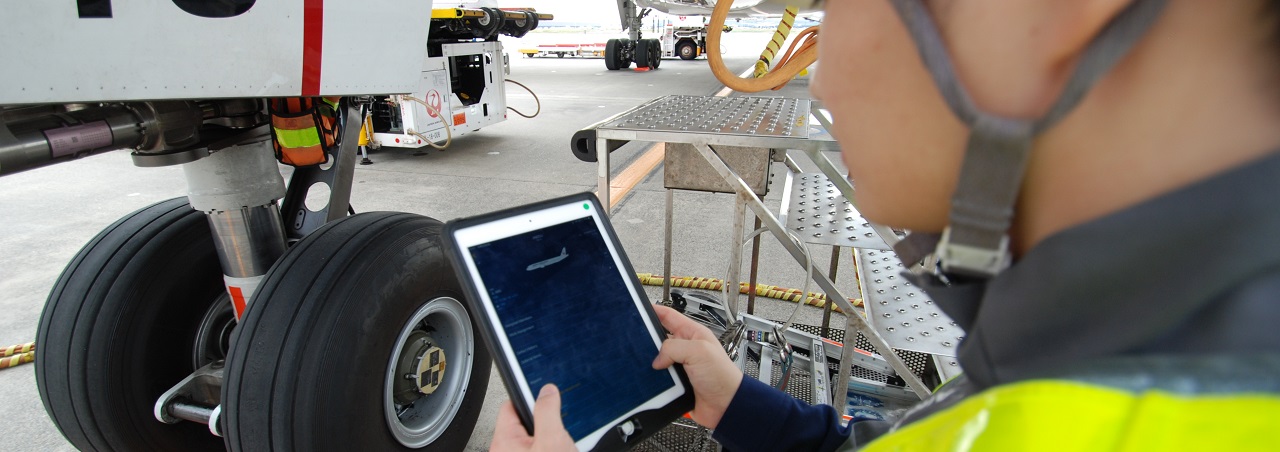
Engineers responsible for maintenance within the JAL Group must carry out accurate and rapid maintenance within limited time windows to ensure aircraft operate safely, comfortably, and smoothly.
In line maintenance, the typical workflow for engineers is that they leave the office in time for an aircraft's arrival, perform the necessary maintenance tasks at the aircraft side (hereafter "at the aircraft"), and return to the office after dispatch. Once at the aircraft, radio was heretofore the primary means of communication. If manuals or other documents were suddenly in need, engineers at the aircraft would radio the office, where a standby engineer would print the necessary documents and deliver them to the aircraft.
After the aircraft's departure, engineers, who return to the office, must also handle tasks such as organizing paperwork by documenting the maintenance performed and entering data into multiple systems. This is work that requires significant time beyond "performing maintenance" itself.
The SMART Project was launched to increase the time engineers can devote to specialized tasks only they can perform and thereby further enhance aircraft quality. Maintenance engineers on the front line, the IT division, and even external partners joined forces, initiating activities under three keywords: Simple, Smart, and Standard.
Simple: Usable by anyone; eliminate duplicate data entry.
Smart: Access diverse information on a handheld device; make errors less likely.
Standard: Standardize business processes; aim for an industry-standard app.
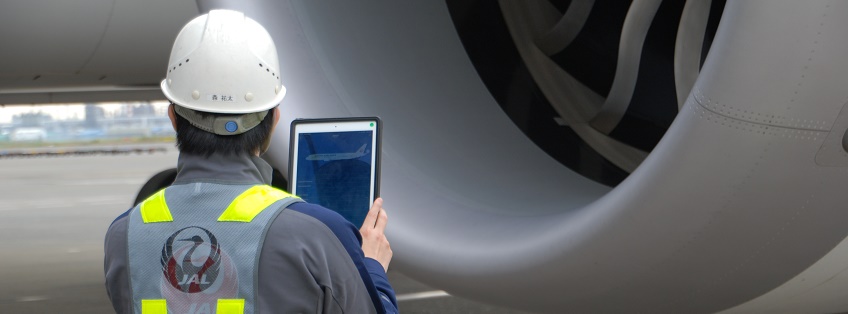
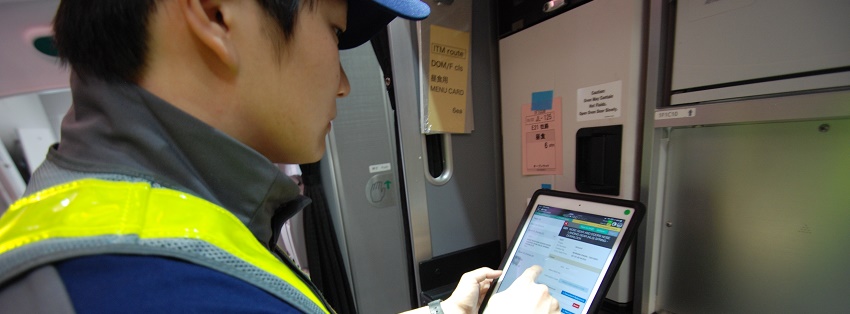
By leveraging a dedicated app, engineers can now perform most of the administrative tasks previously handled in the office from anywhere using a mobile device. They can also easily capture images and videos within the app, enabling timely sharing of aircraft status among parties involved. In addition, they use mobile alerts to stay on top of the latest flight schedules and spot information.
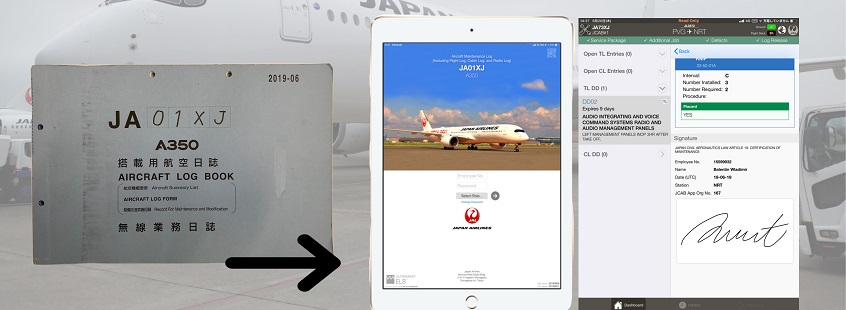
Until now, the onboard aircraft logbooks (flight log), in which cockpit crew, cabin attendants, and maintenance engineers record flight information and corrective actions, as well as the cabin log, had to be a hard copy. To introduce a system for recording and storing these electronically, maintenance engineers discussed a system developed with cockpit crew and cabin attendants. They coordinated legal and regulatory changes with the Ministry of Land, Infrastructure, Transport and Tourism (MLIT). As a result, we obtained Japan's first approval to digitize both the flight and cabin logs. This digitalized logbook was initially used on the Airbus A350 in August 2019 and was later expanded to the Boeing 737 in June 2020.
In April 2017, we began operating with a new way of working using the app. Engineers, who have actually used it, report that "even when maintenance is required on an aircraft prior to departure, we could immediately communicate accurately with the support division via the app and carry out the work with ample time." "We are able to readily obtain the information we needed wherever we were and make swift decisions." In other words, it is already being leveraged as a tool that supports engineers.
However, we must never forget that the engineer's responsibility remains unchanged. IT enables easy, effective, and rapid access to information, but understanding that information and making correct judgments is still essential. We believe that combining engineers' technical capabilities with IT will lead to the improved quality and on-time performance.
This application project is not only for the JAL Group but for aircraft maintenance engineers around the world. By utilizing this app, JAL will transform the work by maintenance engineers, further elevate aircraft quality and on-time performance to world-class levels. Maintenance engineers in Japan will share a new way of working to other engineers in the world.