Maintaining the engine, the "heart of the aircraft", is a vital job that carries both responsibility and reward. One of the key attractions is that it encompasses a wide range of specialized tasks, including nondestructive testing, welding, thermal spraying, machining, assembly, and test runs, offering each person the chance to hone their craft. The skills you acquire can also be applied broadly to airframe and line maintenance.
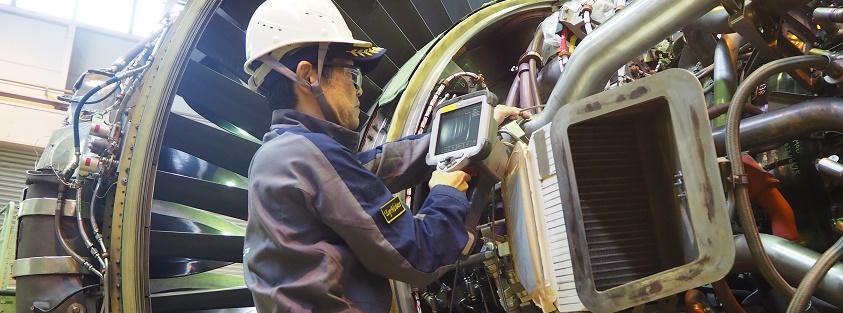
My current duties include initial inspections of engines removed from an aircraft, borescope inspections of internal engine areas, and statutory final confirmation tasks performed after maintenance is completed.
Please share a memorable maintenance task.
One memorable case was a request from line maintenance to retrieve a seal* that had come loose inside an engine, thereby avoiding an engine replacement.
Similar cases were occurring around the world, and because seal retrieval was difficult, many ended in engine changes. Drawing on our daily experience and knowledge, a standard borescope was used to retrieve the dislodged seal to avoid an engine swap. Once the engine was repaired, the aircraft was able to depart on schedule. The sense of accomplishment I felt remains vivid to this day.
(*) Although a missing internal seal does not affect operations, it is necessary to retrieve the seal because the missing seal can cause secondary internal damage.
A message to customers and students
Thank you for choosing JAL.
Our maintenance work safeguards precious lives by transporting customers safely to their destinations. Through reliable maintenance, including preventive work, we deliver high-quality engines and uphold safety in the skies. We will continue to pursue safety so that we remain worthy of your trust.
Students, please challenge yourselves in many ways while at school and find work that matches your aptitudes and gives you a sense of fulfillment.
Engine Maintenance
TAKAGI Yutaro
Engine Maintenance Center
Engine Maintenance Department
What led you to pursue a career as a maintenance engineer?
I became interested in the aviation industry after watching a TV drama when I was at school. I admired the engineers working hard on aircraft maintenance during a visit to the airport and decided to pursue this career. After entering an aviation college and studying aircraft, I grew fascinated by jet engines. I also had the opportunity to tour JAL Engineering. Seeing the complex, large jet engines up close reaffirmed the appeal of maintenance work.
What is the appeal of engine maintenance?
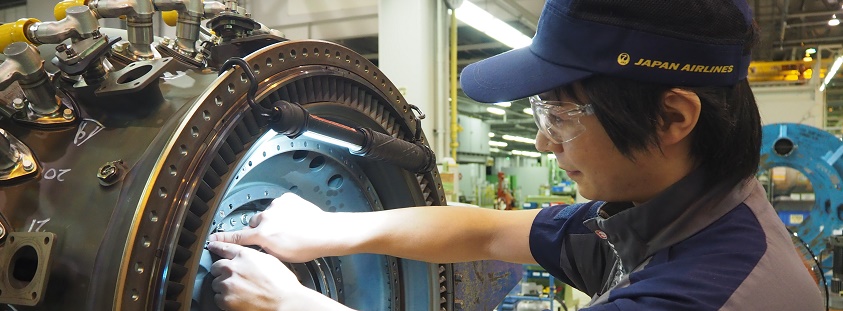
I am responsible for engine disassembly and assembly. What captivates me is when every single part of the powerful engines that drive large aircraft is disassembled and then reassembled back to its original form after cleaning, repairing, and inspecting the parts.
The other point of satisfaction and attraction is being able to perform maintenance while appreciating the differences and characteristics among various engine manufacturers and models for each aircraft type.
It takes roughly 100 days to disassemble and reassemble the engine. The sense of accomplishment when the engineers collaborate together and send out the completed engine is exceptional.
Please share your future goals.
Beyond engine-specific knowledge, I aim to learn aircraft-side skills and knowledge and become a maintenance engineer, who can perform across the board. JAL Engineering handles everything from the maintenance of engines, components, and aircraft. Although I belong to the engine maintenance division, I am currently engaged in heavy aircraft maintenance at Narita Airport, gaining broad knowledge and experience beyond engines. We will continue to carry out flawless maintenance for customers flying with JAL can enjoy safe and secure journeys.